



Joanne McPeake, Colin Hamilton, Leanne M Boehm, Kelly M Toth, Peter Hartley, Characterization of social frailty in survivors of sepsis: a multicenter qualitative investigation, Annals of the American Thoracic Society, Volume 23, Issue 4, April 2026, Pages 575–583, https://doi.org/10.1093/annalsats/aaoaf050
Characterisation of social frailty in survivors of sepsis
Published in:
Annals of the American Thoracic Society
Citation:




Why it matters
People who survive sepsis can experience long-term issues after leaving hospital. These issues can be complex and encompass physical, psychosocial (mental, emotional, social, and spiritual) and cognitive problems.
Because of its significant impact on individuals and the healthcare system, most research and clinical focus relating to issues experienced by sepsis survivors has concentrated on physical frailty. Physical frailty is a condition where people’s strength and ability to recover are reduced, and people who experience physical frailty are at a greater risk of disability and impaired health-related quality of life.
Another type of frailty that may affect sepsis survivors, but is much less understood, is social frailty. Social frailty describes increasing vulnerability due to a loss of the resources needed to fulfil basic social needs. It is known to negatively impact physical outcomes and mortality, leading to higher healthcare costs and increased use of services.
Social frailty after serious or critical illness has not yet been well studied, but it may play an important role in slowing or preventing full recovery. We wanted to understand if social frailty is an important issue following sepsis, how it presents, what drives it and what consequences it has for survivors. To find out, we carried out in-depth interviews with sepsis survivors, their family members, and clinicians from across the UK using the online platform, Thiscovery.
What we found
We found that social frailty appears to be an important factor in recovery after sepsis, but is an area where almost no support or care is currently provided. Many of the drivers of social frailty are also problems often experienced by survivors of critical illness, such as cognitive problems, or new or worsening mental health issues.
Social frailty in survivors of sepsis appeared to be characterised by four major concepts:
- financial insecurity
- social interactions
- ongoing treatment related issues (treatment burden)
- family and relationship challenges (social resources)
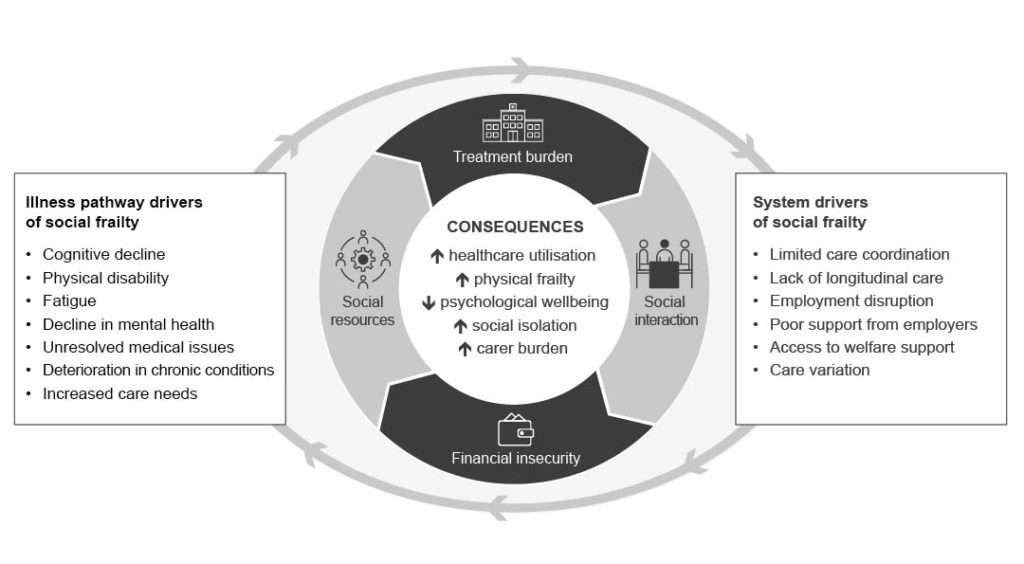
These findings align with existing descriptions of social frailty, which include limited contact and support from others, loneliness, and financial difficulties. An additional concept that emerged was treatment burden – the overall workload and stress that a patient experiences while managing their health conditions. When this workload is greater than an individual’s capacity, it can lead to negative effects including social withdrawal from other aspects of their everyday life. This qualitative analysis of multi-perspective data has characterised the key features of social frailty in survivors of sepsis. Future research should aim to explore how social frailty can be managed throughout recovery, including how services could be implemented in clinical practice.