



Co-designed personalised cancer care


Co-designing personalised care: improving support for cancer
Clair has a clinical background in occupational therapy and a deep commitment to participatory and creative research methods. Her fellowship project focused on colorectal cancer care, examining how patients and clinicians experience the holistic needs assessment (HNA), and where it might fall short. Clair’s study builds on her earlier post-doctoral research, which developed a conceptual framework for living with and beyond cancer. Explaining the framework, Clair says “It focuses on three themes – Adversity, Restoration and Compatibility (ARC) which help explain impact, adjustment, and life after treatment, and are used to structure HNA personalised care conversations and to support people to coproduce their health.”
How the study applied the ARC framework to colorectal cancer care
Working across three NHS Trust sites with five colorectal cancer teams, the study brought patients, clinicians, team leaders and charity partners together to observe care in real-time, and understand how to improve it together. To achieve this, Clair blended participatory methodological approaches across two interconnected sub-studies that were underpinned by design thinking. The first was a video‑reflexive ethnography – a participatory research method that uses video recordings of everyday practices to stimulate reflective discussions and collaborative improvement in healthcare settings – where participants worked as co‑researchers, filming patients and clinicians to understand their experience and spark reflection.
Reviewing video footage opened up previously difficult conversations, created a shared understanding of what needed to change, and helped clinicians view personalised care as meaningful rather than a bureaucratic tick‑box exercise. The second sub‑study used participatory co-design, with participants working as co‑designers, to consider the ARC framework and develop practical improvements. Together, these approaches ensured that improvements were grounded in real experience and co‑produced with all people involved.
Why did Clair choose a THIS Institute fellowship?
Clair’s decision to apply for a fellowship was grounded in shared values: “My focus on studying the co-production of personalised care – and strengthening its evidence base – aligns with THIS Institute’s aims and values.”
The unique combination of academic autonomy and structured support is something Clair found invaluable. Mentoring available through the fellowship helped her navigate methodological questions and pushed her thinking, while the wider fellowship community offered rich perspectives on healthcare improvement.
“The fellowship also offered me space and mentoring to explore the methods used in improvement work. By blending design thinking, video-reflexive ethnography and co-design, the study deepened my understanding of how different participatory methods can be successfully combined.”
Navigating a complex study: scaling participatory research across multiple teams
The project had its share of challenges, said Clair. “One major challenge has been managing the scale of the study – for example, working across three sites with five teams and rolling out the improvement learning across 21 NHS Cancer Alliances in England. Supporting the necessary level of engagement, interdisciplinarity, and creative collaboration where patients, clinicians, team leaders and charity partners are involved as co-researchers and co-designers, required considerable time.”
The strong participant engagement throughout the three-year project strengthened the research and demonstrated what’s possible when the boundaries between research, design and healthcare practice are blurred. This allowed teams to hone improvements that were relevant, acceptable to patients and implementable, resulting in actionable and impactful improvements.
An award for inclusive research
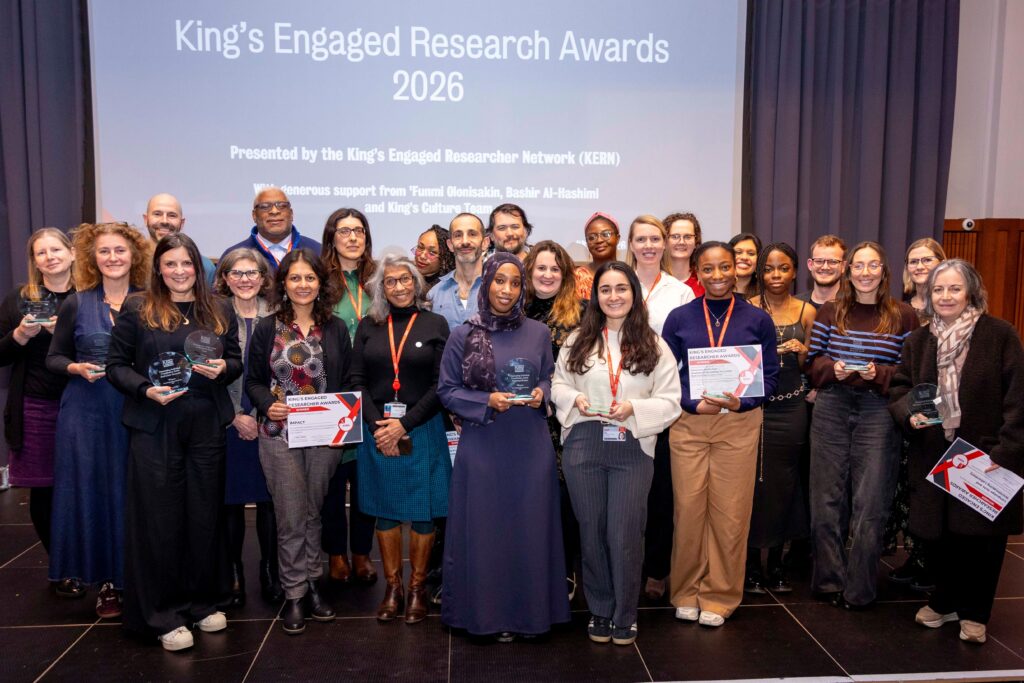
Selected from over 100 nominees, Clair’s project won the Participatory Approaches to Research at the King’s Engaged Research Award at King’s College London. The judging panel recognised it as a benchmark example of participatory research integrated into health service practice. They highlighted its clear, evidenced and multi-level impacts, its implementation outcomes, co-production and inclusion of a diverse set of partners and stakeholders throughout the research.
Clair said “This achievement has increased the project’s visibility, highlighted the value of inclusive research and the impact of my fellowship, and strengthened my reputation as a healthcare improvement leader with expertise in participatory research methods. This recognition will help expand the study’s reach, while also reinforcing the value of partnerships with Macmillan Cancer Support, NHS Cancer Alliances and NHS England, and I hope it will encourage future collaborations in this research area.”
Building a lasting evidence base for personalised care
The project has produced patient-facing resources, including an infographic and animation, which are already helping people to navigate personalised care and support planning.
By sharing findings and co-designed improvements across all 21 NHS Cancer Alliances and collaborating with Macmillan Cancer Support on a blog and many other activities which brought the patient perspective directly to healthcare professionals, the study is helping to shape colorectal cancer care on a national scale.