

Clear, practical microlearning resources on using collaboration-based approaches in healthcare improvement. Includes key features, planning questions, and top tips to support improvement efforts.
Explain THIS: Collaboration-Based Approaches

Navigate sections
Introduction
This resource offers clear, practical guidance on using collaboration-based approaches in healthcare improvement.
After reading this resource, you should be able to:
- Define collaboration-based approaches
- Outline their key features
- Describe four different types of collaboration-based approaches and how they can be used
- Apply eight practical tips for successful collaboration-based approaches to your work.
The resource also includes practical questions to guide planning, alongside links to further reading for deeper insights.
Whether you’re starting a new improvement initiative or looking to expand and sustain existing work, this guide provides actionable advice to support your efforts.
Definitions
Collaboration-based approaches
Collaboration-based approaches describe a variety of ways people in healthcare can work together towards a common goal of improving care.
They bring together groups of professionals, patients, service users, and carers, who share knowledge, coordinate efforts, and support each other in learning and problem-solving.
A collaboration is built on a formal or informal network – a web of connections between people, such as colleagues in the same field, teams working on similar challenges, and patients who may have a shared interest in a health challenge. While networks simply connect people, a collaboration goes further by offering a structured and purposeful way of working together.
Successful collaborations rely on cooperation, shared commitment, and trust. When they work well, they create a cycle where mutual benefits encourage people to stay involved and contribute more, leading to further improvements.
Features of collaboration-based approaches
Based on networks
Though a collaboration needs a network, a network on its own is not a collaboration.
Purpose-driven
Collaborations have shared goals, often focused on improving healthcare quality and patient and service user outcomes.
Mutual learning and knowledge sharing
Collaborations emphasise collective learning. They create an environment where participants identify and share best practices, practical know-how, and lessons learned.
Trust and reciprocity
Effective collaborations build trust, fostering a culture of openness and mutual support. This trust encourages ongoing participation and investment in the collaboration’s success.
Types of collaboration-based approaches
Collaboration-based approaches to healthcare improvement come in different forms. Some were developed within healthcare itself, others have their origins in different fields and have been adapted for healthcare.
They vary in their focus on quality, patient safety, whether they form naturally or are set up intentionally, and how formal or structured they are.
The four different types of collaboration-based approaches below highlight different levels of control, self-organisation, and professional leadership.
Quality Improvement Collaboratives
- Highly organised, with a clear structure, timetable, activities, and events.
- Bring together people from different professions and organisations.
- Typically focus on a specific clinical topic where there are large variations in care or gaps between current and best practice.
- Typically exist for a defined time period.
Communities of Practice
- Groups of practitioners who share a common interest or expertise area.
- Facilitate knowledge exchange, skills development, and sharing practical know-how to support problem solving and workarounds.
- May develop and sustain in organisations that provide the right conditions for them to emerge and flourish.
- May be relatively informal in character and not necessarily engineered into existence.
- Generally decide what they will do rather than having their activities chosen for them or imposed externally.
Managed Clinical Networks
- Clinical professionals working together across organisational and geographical boundaries to solve problems and improve services.
- Tackle complex issues that one organisation cannot tackle alone.
Clinical Communities
- Networks of clinicians and others focused on specific clinical areas or patient populations.
- Balance between self-organising, member-led ethos, and necessary administrative and managerial support.
- Recognise the power of collaboration and professionally led improvement but acknowledge that careful use of control-based devices (such as data to hold units to account) can be helpful.
Eight top tips for collaboration-based approaches
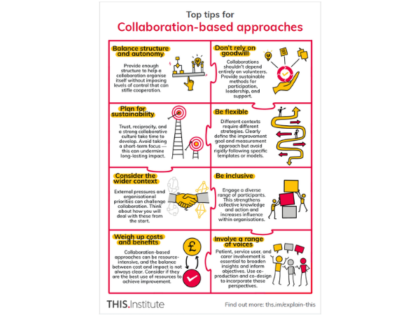
Eight top tips for collaboration-based approaches – text-only version
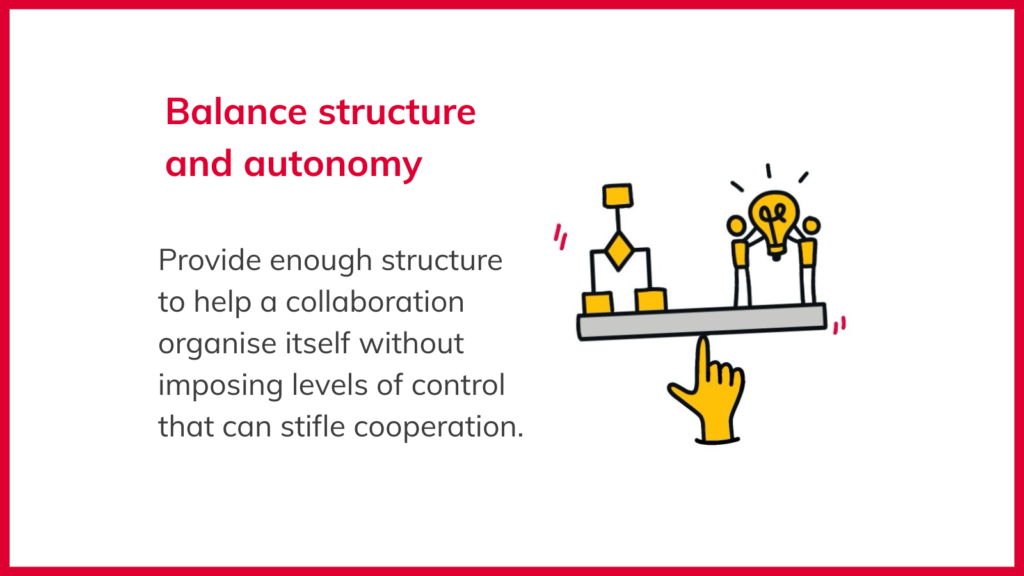
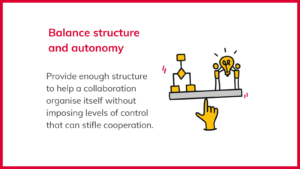
- Balance structure and autonomy: Provide enough structure to help a collaboration organise itself without imposing levels of control that can stifle cooperation.
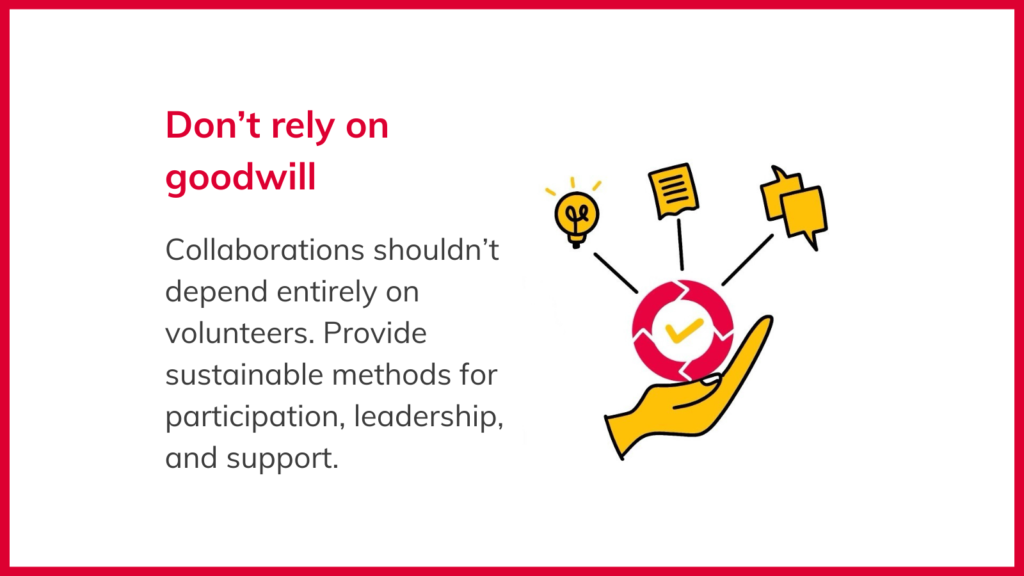
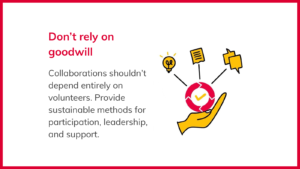
- Don’t rely on goodwill: Collaborations shouldn’t depend entirely on volunteers. Provide sustainable methods for participation.
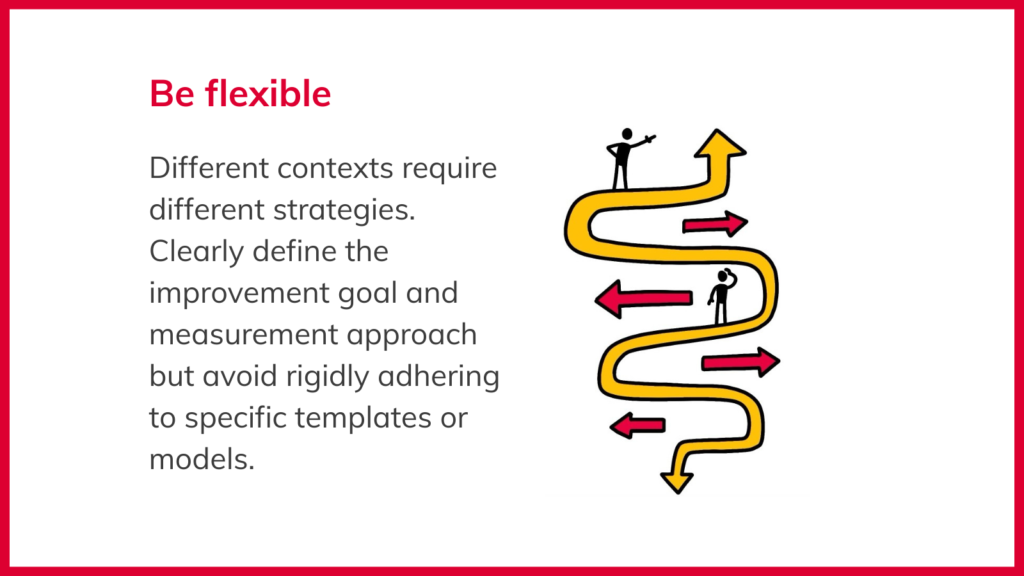
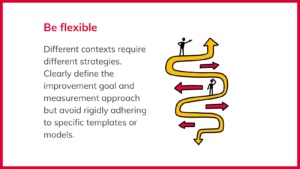
- Be flexible: Different contexts require different strategies. Clearly define the improvement goal and measurement approach but avoid rigidly adhering to specific templates or models.
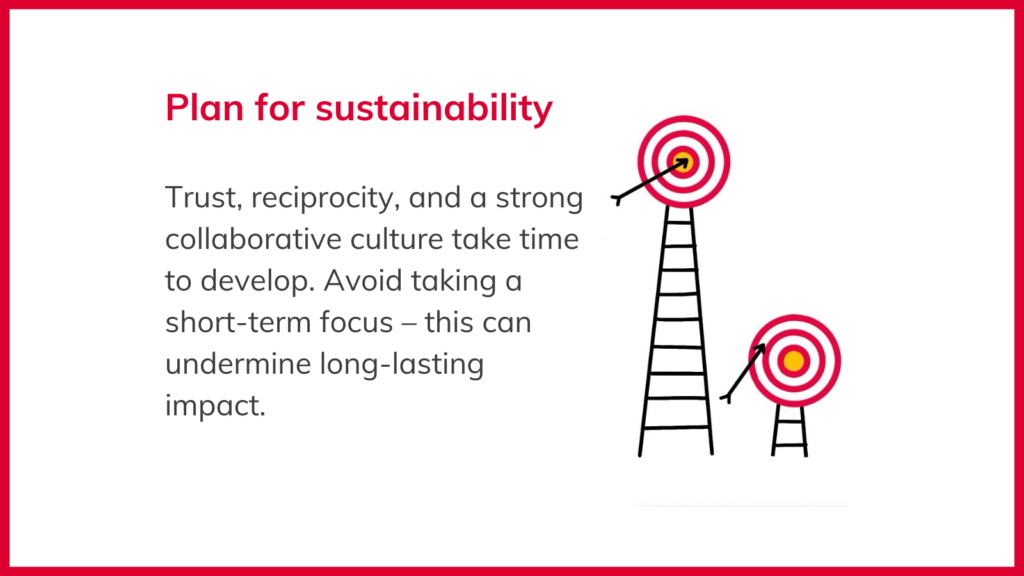
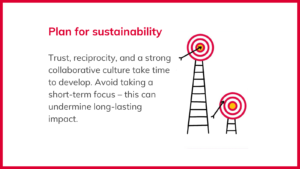
- Plan for sustainability: Trust, reciprocity, and a strong collaborative culture take time to develop. Avoid taking a short-term focus – this can undermine long-lasting impact.
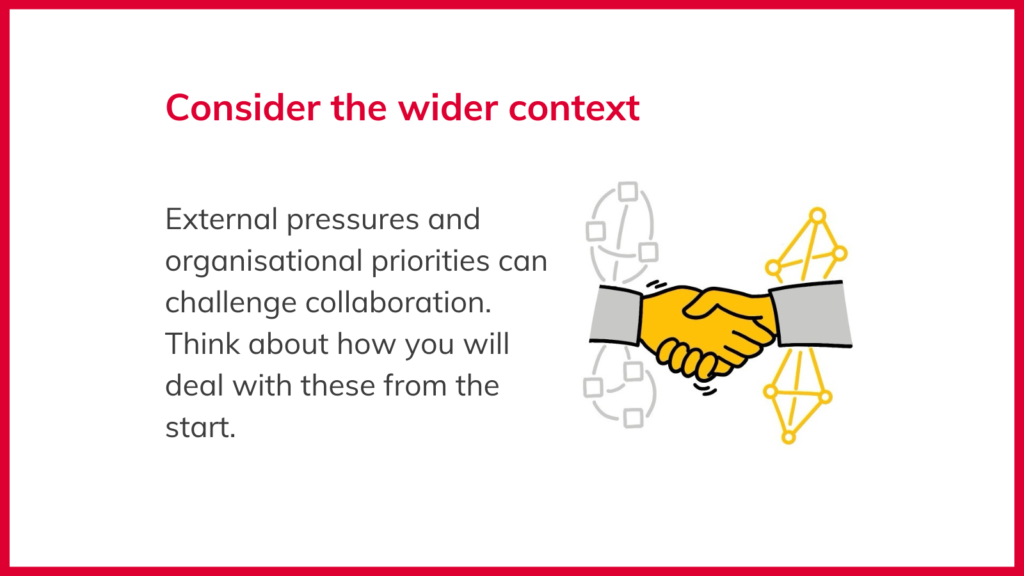
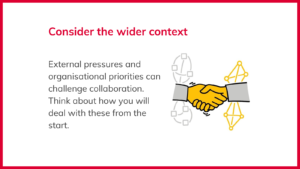
- Consider the wider context: External pressures and organisational priorities can challenge collaboration. Think about how you will deal with these from the start.
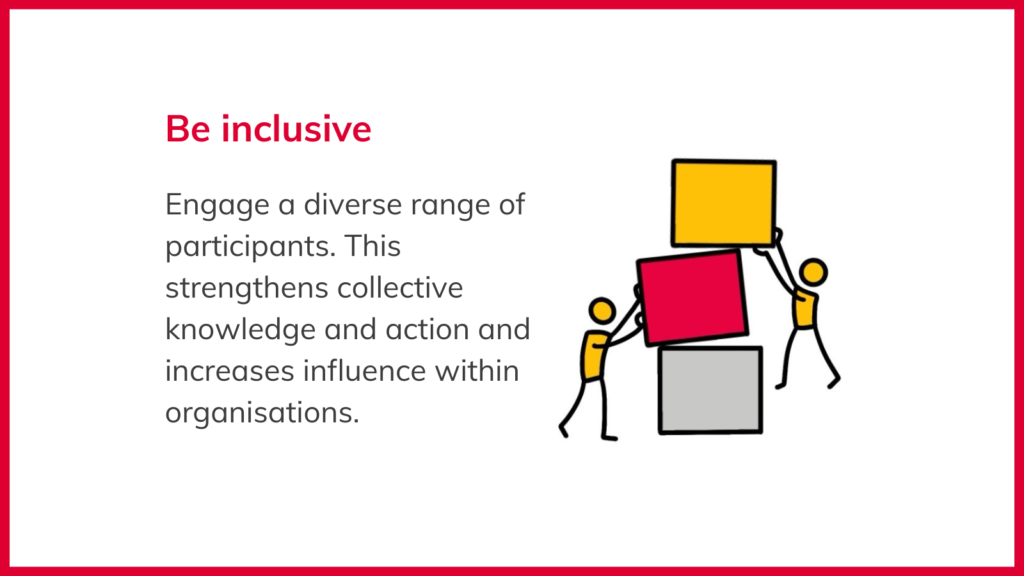
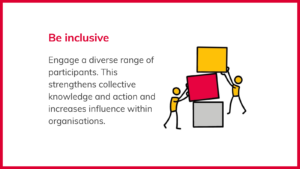
- Be inclusive: Engage a diverse range of participants. This strengthens collective knowledge and action and increases influence within organisations.
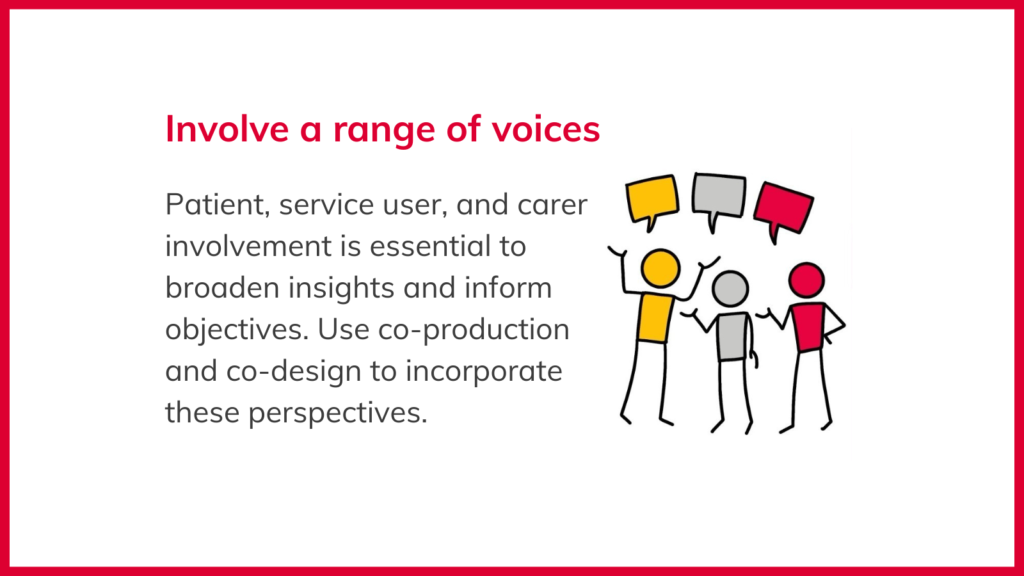
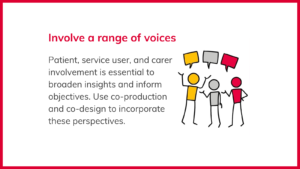
- Involve a range of voices: Patient, service user, and carer involvement is essential to broaden insights and inform objectives. Use co-production and co-design to incorporate these perspectives.
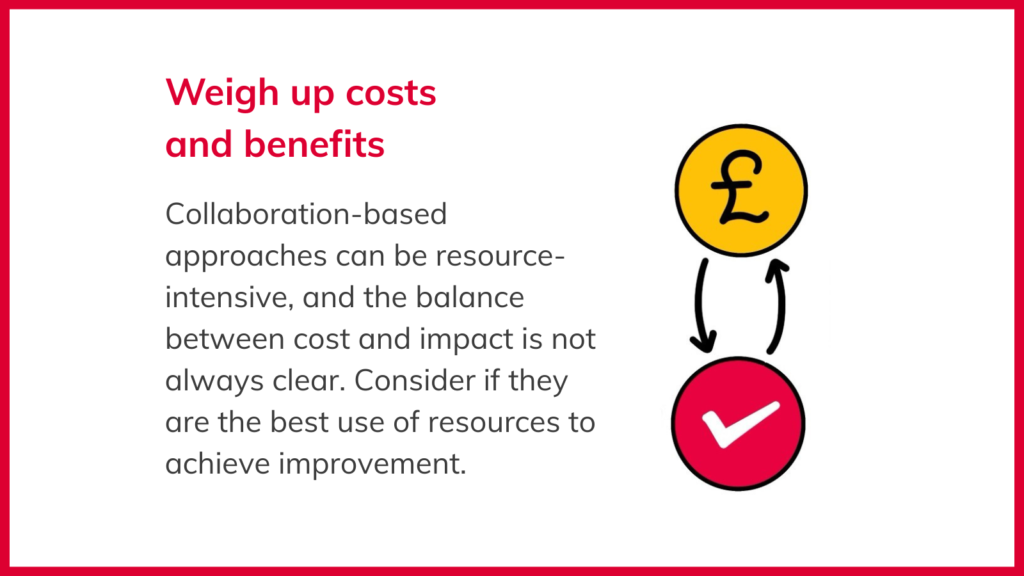
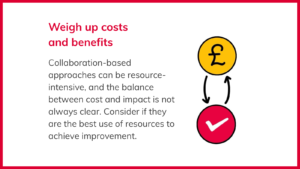
- Weigh up costs and benefits: Collaboration-based approaches can be resource-intensive, and the balance between cost and impact is not always clear. Consider if they are the best use of resources to achieve improvement.
Practical questions
Here are some key questions to help you critically assess whether a collaboration-based approach is the right fit and how to optimise its effectiveness.
Purpose and goals
- What specific problem or challenge are you trying to address through collaboration?
- What are your short-term and long-term objectives? Have they been co-designed?
- How will collaboration lead to better outcomes than working independently?
Stakeholders and participation
- Who needs to be involved for the collaboration to be effective?
- How will you invite membership? Who the invitation comes from can matter as much as the invitation itself. The language and tone of the invitation also matter.
- How can you ensure diverse perspectives, including those of patients, service users, carers, and staff in different roles, are represented?
- What strategies will you use to engage and sustain participation? How will you build trust between members of the collaboration?
- How will accessibility needs be taken into consideration and addressed to ensure equity of participation?
Structure and process
- What type of collaboration-based approach best suits your goals?
- How will roles and responsibilities be defined within the collaboration?
- What governance or decision-making structures will be in place?
- How will you manage conflicts or differences in priorities among collaborators?
- How will the collaboration be embedded in and engage with the organisational system?
- What lessons from past collaborative efforts can you apply to improve this one?
Subject matter expertise
- How will you provide assurance that subject matter is up to date and accurate?
- What skills do you have or need to develop to lead, convene, or facilitate the collaborative, or where can you access these?
Resources and sustainability
- What time, funding, and resources are needed to make the collaboration successful?
- How will you ensure that the collaboration remains sustainable in the long run? Or is it a short-term collaborative?
- What potential barriers might limit your ability to collaborate effectively, and how can you address them?
Evaluation and impact
- How will you monitor the impact and success of your collaboration?
- How will you ensure that the learning from the collaboration is shared more widely?
Adaptability and future planning
- How will you adapt if your initial approach does not yield the expected results?
- How can you embed a culture of collaboration into routine practice beyond this specific initiative?
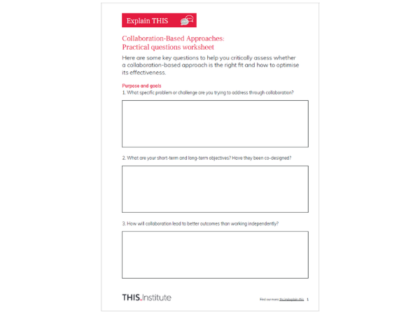
You can download these practical questions as a printable worksheet, with space to note down your responses.
Further reading
THIS Institute | Graham Martin and Mary Dixon-Woods
Collaboration-Based Approaches
https://doi.org/10.1017/9781009236867
The Health Foundation
Effective networks for improvement
https://www.health.org.uk/reports-and-analysis/reports/effective-networks-for-improvement
Institute for Healthcare Improvement
The Breakthrough Series: IHI’s Collaborative Model for Achieving Breakthrough Improvement
https://www.ihi.org/library/white-papers/breakthrough-series-ihis-collaborative-model-achieving-breakthrough
Health Services Executive
Improvement Collaborative Handbook
https://www2.healthservice.hse.ie/organisation/qps-improvement/quality-improvement-collaboratives/
The Health Foundation
Using clinical communities to improve quality: Ten lessons for getting the clinical community approach to work in practice
https://www.health.org.uk/reports-and-analysis/reports/using-clinical-communities-to-improve-quality
Q Toolkit
Creative approaches to problem solving
https://q.nhsconfed.org/resources/creative-approaches-to-problem-solving
Acknowledgements
This resource was adapted from Collaboration-Based Approaches, by Graham Martin and Mary Dixon-Woods, part of THIS Institute’s series ‘Elements of Improving Quality and Safety in Healthcare’.
Thank you to Juanita Guidera, National Quality and Patient Safety, Health Service Executive, for her insightful comments and recommendations.
Download the resources
Worksheet
You can download the practical questions as a printable worksheet, with space to note down your responses.
Sketchnote
Download the sketchnote, featuring eight top tips for collaboration-based approaches.