



How can improvement and innovation save the NHS?


Innovation and improvement efforts have the potential to make a big difference to the NHS, although poor problem diagnosis, weak solution design, failure to address deep structural and cultural challenges, fragmentation, and inadequate evaluation remain major challenges. But there is hope. If the NHS adopts three capabilities: understanding problems, developing solutions, and evaluating them, it has the potential to succeed in a context of constrained resources.
No more zombie solutions
The NHS does not lack great ideas or talented people. But it does have a tendency to introduce solutions (both policy-driven and local) without properly understanding the underlying problems, designing for real-world implementation, or undertaking rigorous evaluation.
Repeatedly trying the same thing, even when it didn’t work before, only adds to the challenges, creating distraction and waste. That is why similar issues keep recurring despite decades of initiatives.
Asking the hard questions up front – “Have we correctly diagnosed the problem, co-designed solutions with patients and staff, engineered the work systems, and planned for evaluation?” – is a much more promising approach.
Understanding problems
Too often, innovation and improvement efforts proceed based on poor understanding of the problem to be solved. Some problems are fundamentally down to capacity and structure. That is where policy tends to focus, often preoccupied with staffing levels, buildings and so on.
But processes and systems – how work gets done – matter too. For instance, time-and-motion studies in general practice show that staff are working very hard, but large amounts of their time are lost to operational failures and compensatory labour (extra work caused by things like staff shortages, mistakes, or inefficient systems) that remain largely invisible.
These problems often arise because so many mundane but essential processes across the NHS have never been properly designed or tested. This leads to frustration, safety risks, and poor experience – as well as resource waste. It also helps to explain why organisations that seem structurally similar can produce different outcomes, and why available capacity is not always used optimally.
Additional staff, funding, or technology may all be needed, but still fail to deliver benefits unless underlying work systems and processes are redesigned. For example, access to general practice is widely recognised as a problem. But simply increasing the number of appointments or adding new digital booking systems can miss how people become candidates for care, and why some groups are more disadvantaged than others.
Design once, adapt locally
Unwarranted variation (differences in healthcare services, outcomes, or patient experiences that cannot be explained by patients’ needs, preferences, or medical evidence) has continued to be the bane of the NHS, as it is for many other health systems. It leads to inequity and waste, with patients not consistently getting the care they need. But the NHS has not taken full advantage of one of its greatest assets – its status as a national system. Rather than the current proliferation of multiple local initiatives, more could be achieved through collective action using structured methods – designing things really well at scale, just once, and then adapting them locally as needed.
Sometimes, too, the solution may already exist in the system, so we should look for examples of positive deviance. This requires identifying high-performing units that are already excelling, characterising what they are doing, and turning those insights into scalable solutions for the rest of the NHS.
The solutions may already exist, and if they do, we must identify the high performers, figure out what they’re doing, turn it into something everyone can do, and support that with large scale collaboration.
Improvement and innovation in an era of technology
High-profile technologies can easily dominate policy attention and headlines.
New technologies have an important role in addressing some of the NHS’s most pressing challenges. But there is a real danger of forgetting some hard-won lessons: the hype can outrun the evidence, significant upfront planning and design effort is needed, risks of deepening inequalities abound, and a great deal of money, energy and goodwill can easily be squandered.
Technology may be shiny, but the hard work needed to realise its benefits is often profoundly unglamorous
Successful change is rarely just a technical fix. It needs significant social, cultural, and emotional work too, and deliberate attention to equity, fairness, and trust. For technology to succeed, it must be intentionally co-designed as part of a sociotechnical system – one that comprises people, tools and technologies, cultures, practices, policies, and infrastructures that interact dynamically to produce system behaviour, risks, and outcomes.
Without this understanding, we’ll see increasing numbers of expensive technology failures.
Some of the hardest challenges are cultural and institutional, not technical
Service redesign and innovation are critical to the future of the NHS. But some of the most persistent problems involve organisational degradation, failures of voice, bullying, racism, and harassment. Current systems are poorly set up to handle many of these problems, for example because they focus on individuals and formal processes, while the actual barriers to voice are relational, cultural, and institutional. Technology is unlikely to provide the answer. Critical, too, will be addressing secrecy, credibility gaps, fear, and the legal and regulatory context that can make some concerns effectively “unvoiceable.”
Infrastructural support for improvement, innovation, and evaluation
Evaluation is a particular weakness for the NHS. While there are pockets of excellence, too little learning is formally captured, and even when it is, it is not used to inform the next phase of initiatives. The NHS may now be entering a cycle in which political enthusiasm for innovation outpaces the system’s evaluative capacity. Methodological and infrastructural capacity is needed to deliver evaluation closer to real time, and more efficiently, than is currently possible.
Critical to all of this is collaboration between those who work in healthcare systems and those who use them. The work to understand problems, identify solutions and evaluate them will always need to happen in person. But, increasingly, THIS Institute research has shown that digital approaches can enable people to come together online and collaborate in new ways. One benefit of doing things online is scale: people can engage in co-design, consensus-building, and feedback, as well as joining conversations and learning from each other in ways that are otherwise hard to achieve.
Improvement and innovation can indeed help save the NHS, but only if they are treated as system-level practices supported by strong methods and infrastructures, operating in disciplined but creative ways, and at scale.
THIS Institute annual lecture 2026
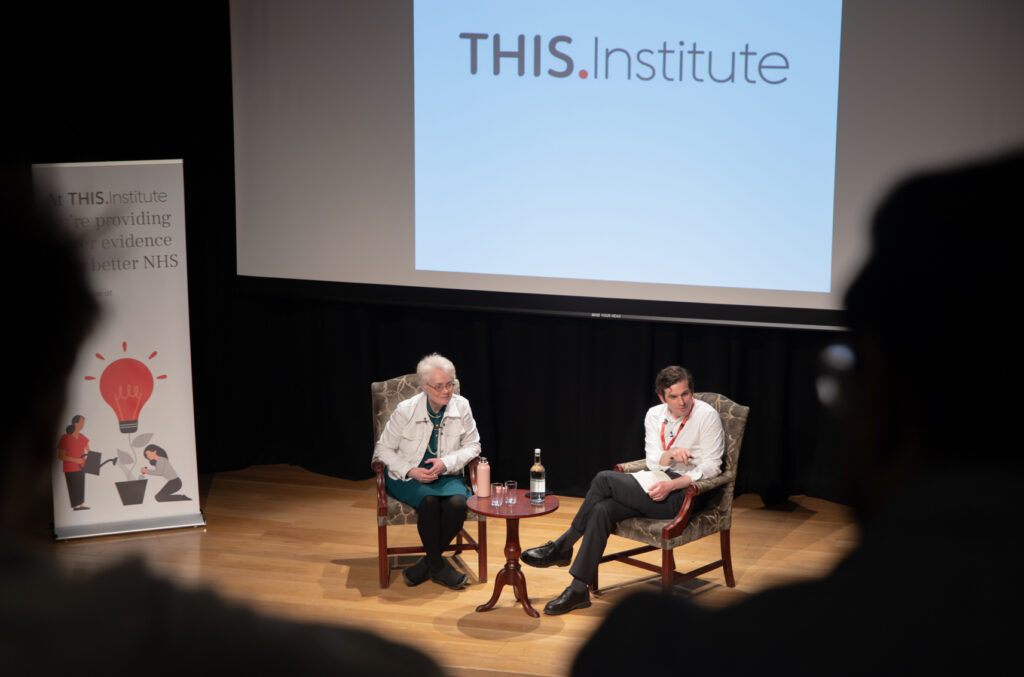
THIS Institute’s 2026 annual lecture was delivered by Professor Mary Dixon-Woods on 6 May 2026. In the lecture, Mary offered a cautiously optimistic analysis of how the NHS can succeed in a context of constrained resources.
To learn more about how to build a healthcare system designed for the future, watch the full lecture below.