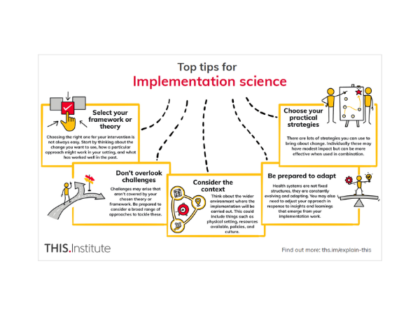

Clear, practical microlearning resources on using implementation science in healthcare improvement. Includes key frameworks, planning questions, and top tips to support improvement efforts.
Explain THIS: Implementation Science

Navigate sections
Introduction
This resource offers clear, practical guidance on the key concept of implementation science in healthcare improvement.
After reading this resource, you should be able to:
- Define implementation science and its areas of focus
- Describe five theories and frameworks to help you anticipate, identify, and explain the key features that will influence change
- Describe practical implementation strategies can be used to put interventions into action
- Consider five key practical tips for implementation science and how they apply to your work.
The resource also includes practical questions to guide the planning, doing, and evaluation of implementation, alongside links to further reading for deeper insights.
Whether you’re starting a new improvement initiative or looking to expand and sustain existing work, this guide provides actionable advice to support your efforts.
Definitions
A healthcare intervention might be shown to be effective – but that doesn’t guarantee it will become used in routine practice. In this gap between research and real-world practice sits implementation science.
Implementation science is the study of how to support the uptake of evidence-based interventions in healthcare practice and policy.
It has three areas of focus:
- Understanding what influences implementation – the systems, behaviours, and practices.
- Evaluating strategies to address the factors that block or support implementation.
- Looking at how implementation happens – what gets implemented, when, why, and how?
Any kind of implementation means change. To support this, it’s important to clearly understand:
- What is being introduced?
- Where is the change happening?
- Who is involved?
- What processes and resources are needed?
- What is the wider, economic, political, and social environment?
Theories, frameworks, and practical strategies
A number of theories and frameworks can help you anticipate, identify, and describe the key features that will influence change.
Choosing the right one for your intervention is not always straightforward, but it helps to start by thinking about the change you want to see and how a particular approach might work in your setting. The questions at the end of this resource can help to guide you.
In the following sections we introduce five widely used frameworks that can be used on their own or in combination, and practical strategies that can be used to put interventions into action.
COM-B – useful for changing behaviours
COM-B is a widely used and accessible model that can be used at individual and team level, as well as at organisation level. It focuses on three components and how they interact to change a behaviour:
- Capability – does the person have the knowledge and skills?
- Opportunity – are there the right conditions and resources?
- Motivation – does the person want to do the new behaviour?
Example
NHS England’s infection prevention and control education framework used the COM-B model to identify what was preventing target behaviours for infection prevention and control.
Use this framework to:
- Understand and explain what influences implementation outcomes.
- Evaluate implementation efforts.
Theoretical Domains Framework (TDF) – useful for changing behaviours
Theoretical Domains Framework (TDF) is a framework to identify factors that influence behaviour, useful for when a more detailed approach is needed. Organised into 14 domains, it covers factors including knowledge, skills, beliefs, motivation, and context. It is often used alongside COM-B.
Example
East London NHS Foundation Trust used TDF to explore why evidence-based guidelines for pressure ulcer prevention and management were inconsistently implemented.
Use this framework to:
- Understand and explain what influences implementation outcomes.
- Evaluate implementation efforts.
Consolidated Framework for Implementation Research (CFIR) – useful for understanding context and wider systems
Consolidated Framework for Implementation Research (CFIR) provides a structure for understanding the contexts where implementation will happen. It focuses on the:
- Characteristics of the intervention
- Outer setting – values, policies, financing, etc.
- Inner setting – culture, resources, communications, etc.
- Characteristics of individuals
- Implementation process.
Example
The community rapid intervention service (CRIS), developed in North Staffordshire and Stoke-on-Trent, used CFIR to evaluate the service.
Use this framework to:
- Understand and explain what influences implementation outcomes.
- Evaluate implementation efforts.
Promoting Action on Research Implementation in Health Services (PARIHS) – useful for making a new practice routine
Looks at the interaction of three core elements for moving research into practice at an organisational (rather than individual) level:
- The strength and nature of the evidence
- The context or environment where the evidence is used
- How implementation is carried out.
Example
Multiple case study of four implementation projects showing how the framework has been used by diverse implementation project teams.
Use this framework to:
- Understand and explain what influences implementation outcomes.
- Evaluate implementation efforts.
RE-AIM – useful for evaluating interventions
A framework for planning and evaluation of interventions according to five key constructs:
- Reach
- Effectiveness
- Adoption
- Implementation
- Maintenance.
Example
RE-AIM was used to evaluate a diabetes prevention programme in primary care.
Use this framework to:
- Evaluate implementation efforts.
- Guide the process of implementation.
Practical strategies
Implementation strategies can be used to put the intervention into action. They can be used across various settings and contexts. Using them in combination is often more effective. Some commonly used strategies include:
- Audit and feedback (such as performance targets and an action plan)
- Computerised reminders to follow the new process or behaviour
- Educational meetings and training
- Facilitation by experts to bring about change
- Financial incentives that target behaviours
- Local opinion leaders reinforcing why change is needed
- Printed educational materials to display and distribute
- Quality improvement collaboratives – groups that come together to learn, apply, and share improvement methods.
Five top tips for implementation science
Five top tips for implementation science – text-only version
- Select your framework or theory: Choosing the right one for your intervention isn’t always easy. Start by thinking about the change you want to see, how a particular approach might work in your setting, and what has worked well in the past.
- Don’t overlook challenges: Challenges may arise that aren’t covered by your chosen theory or framework. Be prepared to consider a broad range of approaches to tackle these.
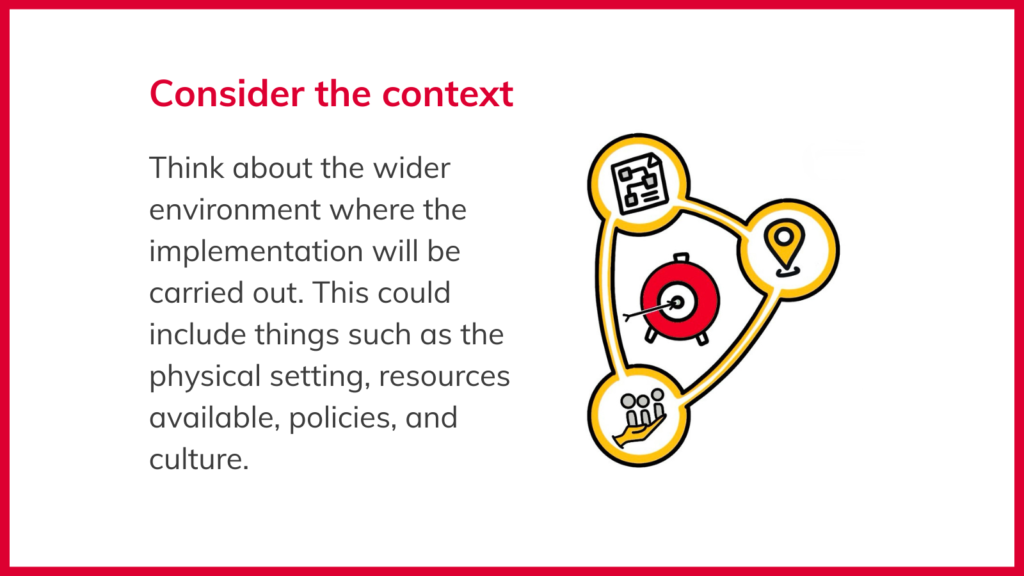
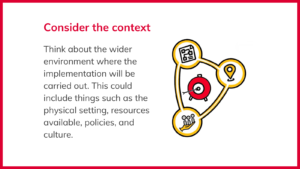
- Consider the context: Think about the wider environment where the implementation will be carried out. This could include things such as the physical setting, resources available, policies, and culture. Be prepared to adapt
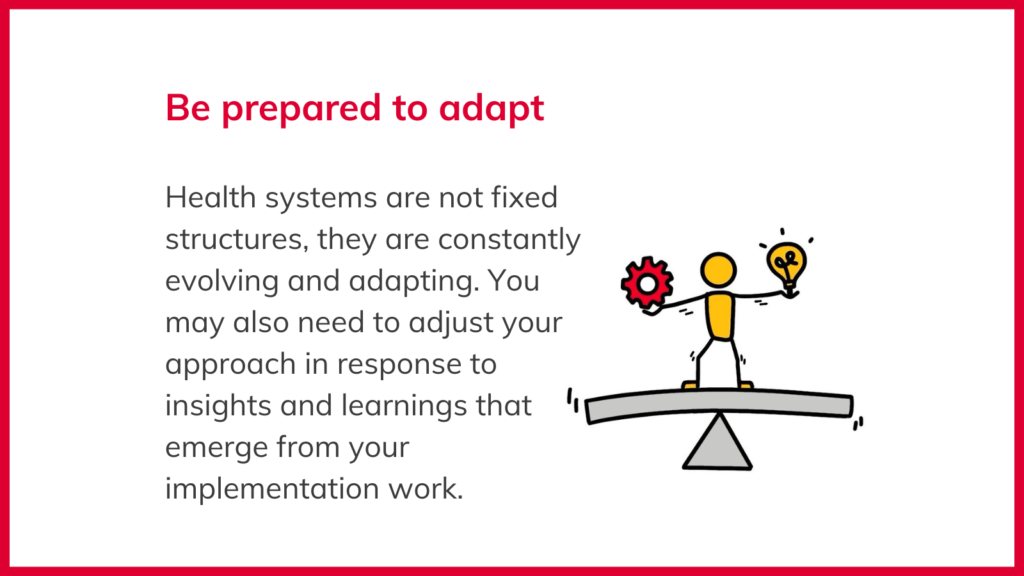
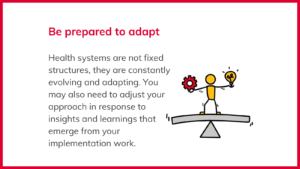
- Health systems are not fixed structures, they are constantly evolving and adapting. You may also need to adjust your approach in response to insights and learnings that emerge from your implementation work.
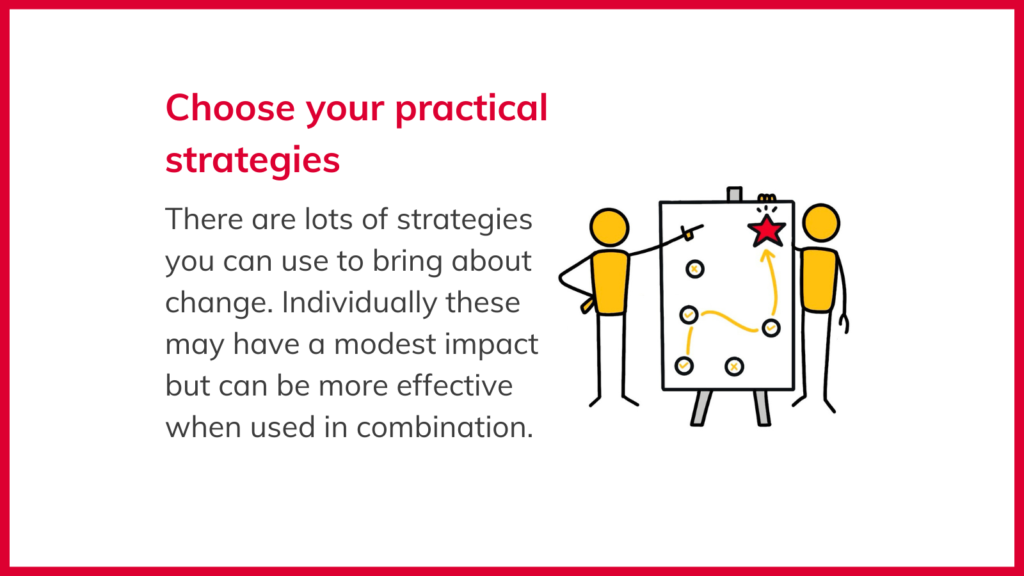
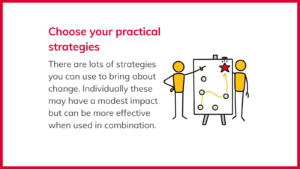
- Choose your practical strategies: There are lots of strategies you can use to bring about change. Individually these may have a modest impact but can be more effective when used in combination.
Practical questions
Asking the right questions can help you select a theory or framework and guide the planning, doing, and evaluation of implementation.
Context and organisational readiness
- Has your organisation run implementation projects before?
- What could be learnt from projects that have gone before?
- Is the culture at your organisation open to implementation of new projects? Consider all levels.
- What is your aim, and what do you need to understand?
- Do you need to better understand barriers and enablers?
Stakeholders and leadership
- Who are you working with: individuals, teams, or wider settings?
- Who are the key stakeholders at all levels? Are they engaged in the process? Is there any endorsement that needs to be obtained?
- Who will lead this change process and why?
Theory and frameworks
- Where in the process do you need to use a theory or framework?
- Does your approach lend itself particularly to design and planning, the process of implementation, or to evaluating implementation success?
- Does the theory or framework you are considering fit the organisational level(s) where your project is being implemented?
- Do you have the knowledge, capability, and capacity to use your chosen model? If not, who could you partner or work with to help you think about how to apply this model in practice?
- Could more than one theory or framework be useful?
Planning and resources
- Do you have a robust business plan in place?
- How might project management help and support the process?
- What resources are needed (and what are currently available)?
- How many staff are needed and what time is available to them to participate in the implementation project?
- Is any external resource needed?
Strategies, outcomes, and evaluation
- What practical strategies could you use to support implementation?
- Consider the list of practical strategies. Would any of these be applicable and feasible in your setting?
- What are the intended outcomes of the implementation? What data will you collect to assess these outcomes and why? How will you collect the data and who will do this?
- Does the data that will be available fit with your theory or framework?
- What are the possible adverse outcomes of the implementation? How could these be planned for and mitigated?
- Is there potential for spread of this work to other settings?
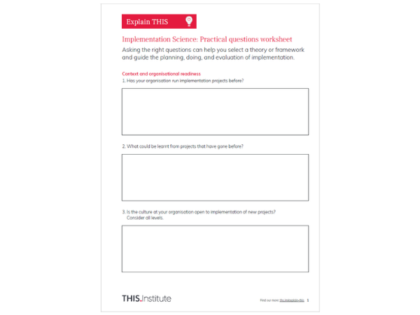
You can download the practical questions as a printable worksheet, with space to note down your responses.
Further reading
THIS Institute | Paul Wilson and Roman Kislov
Implementation Science
https://doi.org/10.1017/9781009237055
Centre for Effective Services
An Introductory Guide to Implementation
https://implementation.effectiveservices.org/
NIHR Applied Research Collaboration Wessex
Web-based Implementation Toolkit
https://www.arc-wx.nihr.ac.uk/web-implementation-toolkit
Cancer Prevention and Control Research Network
Putting Public Health Evidence into Action: Module 5: Implement Evidence-based Interventions
https://cpcrn.org/training
King’s Improvement Science/University of East Anglia
Implementation Outcome Repository
https://implementationoutcomerepository.org/
The Center for Implementation
Creating impact with evidence-based implementation – free online course
https://thecenterforimplementation.teachable.com/p/inspiring-change
THIS Institute | Chrysanthi Papoutsi, Tricia Greenhalgh, Sonja Marjanovic
Approaches to Spread, Scale-Up, and Sustainability
https://doi.org/10.1017/9781009326049
This resource was adapted from Implementation Science, by Paul Wilson and Roman Kislov, part of THIS Institute’s series ‘Elements of Improving Quality and Safety in Healthcare’.
Thank you to Anna Burhouse (Northumbria Healthcare NHS Foundation Trust), Julie Smee (NHS England South West), and Vardeep Deogan (North Bristol NHS Trust) for their insightful comments and recommendations.
Download the resources
Full resource
The full resource is available to download as a PDF for free. We hope that you find it useful in your work.
Worksheet
You can download the practical questions as a printable worksheet, with space to note down your responses.