



Clear, practical microlearning resources on making culture change happen in healthcare improvement. Includes key definitions and tools, planning questions, and top tips to support improvement efforts.
Explain THIS: Making Culture Change Happen

Navigate sections
Introduction
This resource offers clear, practical guidance on making culture change happen in healthcare improvement.
After reading this resource, you should be able to:
- Define organisational culture and explain why culture change matters
- Describe ways to manage and assess culture change
- Identify key characteristics of successful culture change.
The resource also includes practical questions to guide planning, alongside links to further reading for deeper insights.
Whether you’re starting a new improvement initiative or looking to expand and sustain existing work, this guide provides actionable advice to support your efforts.
Definitions
Many inquiries into failures in quality and safety in the NHS have identified organisational culture at the root. But culture is not easy to define and culture change is even harder to achieve, particularly in systems characterised by complexity such as NHS organisations.
Organisational culture
Organisational culture can be defined in many ways, but most descriptions share common elements. One way of thinking about culture is ‘how we do things around here’ – the shared habits, beliefs, attitudes, practices, routines, social norms, and unwritten rules that shape everyday behaviour.
Culture operates at different layers:
- the visible things like uniforms and rotas
- the values people say they hold
- deeper assumptions that guide how care is delivered.
Everyone contributes to culture, not just managers. Culture is created in thousands of everyday interactions and in how we treat colleagues and patients.
Why does culture matter?
Culture is powerful
Culture influences what feels normal, acceptable, or possible – whether that’s how we escalate concerns, speak to colleagues, or treat patients. It’s not uncommon for the culture of an organisation as described in mission statements and websites to be quite different from the culture experienced in practice.
Culture is founded on assumptions
Culture is founded on often hidden assumptions that can be difficult to recognise once we’re inside it. Shared ways of thinking and behaving shape what is acceptable in a group setting – but can be taken for granted to the extent of being almost invisible.
NHS organisations rarely have one culture
Different professions, wards, units, shifts, and teams often develop their own subcultures, so nurses, managers, doctors, porters, and receptionists may all experience the organisation differently. These differences can cause complexity and make conflicts hard to resolve, but they can also be a source of strength when understood and managed well.
The NHS workforce is diverse and staff from other countries may bring different values and beliefs. Public opinion, media coverage, and regulatory frameworks are also influential.
Tools for assessing and managing culture change
Research shows links between positive cultures and better outcomes, but the picture is complicated. Some studies suggest that organisations with strong learning environments, good relationships, and openness perform better. But it’s not as simple as ‘good culture equals good results’ – and trying to engineer culture from the top down rarely works.
One place to start is with assessing the culture. A number of tools are available, but they vary in what they examine. They are probably best considered as one element alongside other approaches, such as talking to people informally, interviews and focus groups, and observations and walking around.
Tools for assessing culture
Safety Attitudes Questionnaire (SAQ)
- Widely used survey to assess patient safety culture.
- Covers six areas: safety climate, teamwork, stress recognition, perceptions of management, working conditions, and job satisfaction.
- Completed by individuals, with scores added together to give a picture of an organisation’s safety culture.
- Adapted for use in settings including primary care, nursing homes, long-term care facilities, and intensive care units.
Manchester Patient Safety Framework (MaPSaF)
- Qualitative tool exploring nine areas of patient safety.
- Describes what an organisation would look like at different levels of maturity in relation to patient safety – from ‘pathological’ (why do we waste our time on patient safety issues?) to ‘generative’ (managing patient safety is an integral part of everything we do).
- Assessments via facilitator-led workshops can prompt reflections, stimulate discussions, and help understand strengths and weaknesses.
- Originally developed for use in the primary care sector and adapted for use in other healthcare settings.
Culture of Care Barometer (CCB)
- Self-assessment tool to help healthcare organisations measure the culture of care they provide and explore certain areas of culture in greater depth.
- 30 questions are grouped into four broad areas: the resources to deliver quality care; the support needed to do a good job; a worthwhile job that offers the chance to develop; and the opportunity to improve team working.
Key characteristics of successful culture change
Psychological safety and speaking up
Enabling staff to raise concerns without fear is essential. When ‘untouchables’ or a ‘culture of fear’ exist, patient safety suffers. Structured efforts to support speaking up, such as clearer processes and better leadership behaviours, can make a real difference.
Leadership that listens and learns
Successful organisations have leaders who show up, support teams visibly, and encourage honest conversations. They mix clear expectations (‘transactional’ leadership) with inspiration and support (‘transformational’ leadership), depending on what’s needed.
Cross-disciplinary teamwork
Bringing together staff across roles, involving diverse voices, and tackling conflict constructively helps shift culture and improve care.
Structures that support collaboration
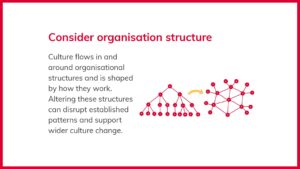
Hierarchies, reporting lines, and siloed departments can make cultural change harder. Adjusting structures to support teamworking and communication can help cultures shift naturally.
Small, steady changes matter
Culture rarely changes overnight. Most progress comes from sustained, incremental improvements, not sweeping reforms. The goal is often nurturing positive habits rather than engineering a ‘new culture’ from scratch. Resistance to change is normal and needs to be anticipated and handled appropriately. It’s important to find the balance between keeping what works well and identifying the cultural aspects that need to be improved or replaced.
Culture isn’t about slogans, posters, or new mission statements
It’s about:
- how teams behave with each other and towards patients every day
- how safe people feel to speak up
- how leaders respond to concerns
- how values show up in real decisions
- how staff are supported to learn and improve.
Seven top tips for making culture change happen
Seven top tips for making culture change happen – text-only version
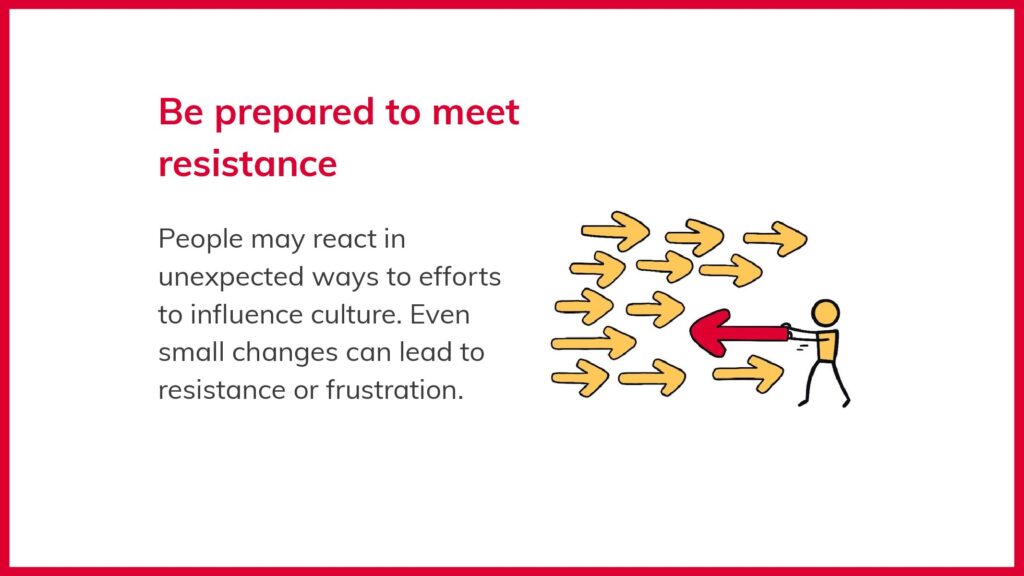
- Be prepared to meet resistance: People may react in unexpected ways to efforts to influence culture. Even small changes can lead to resistance or frustration.
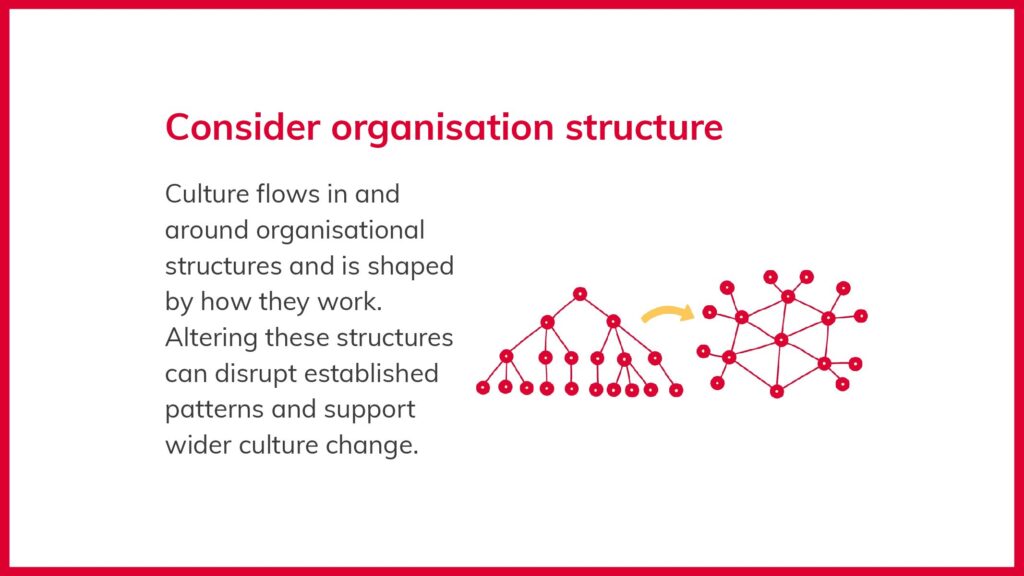
- Consider organisation structure: Culture flows in and around organisational structures and is shaped by how they work. Altering these structures can disrupt established patterns and support wider culture change.
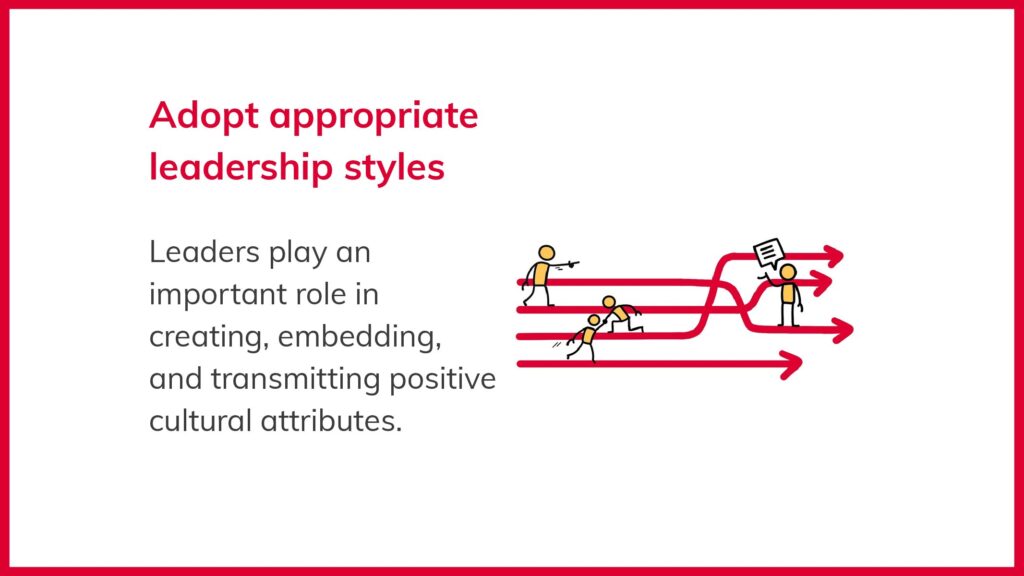
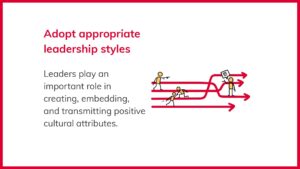
- Adopt appropriate leadership styles: Leaders play an important role in creating, embedding, and transmitting positive cultural attributes.
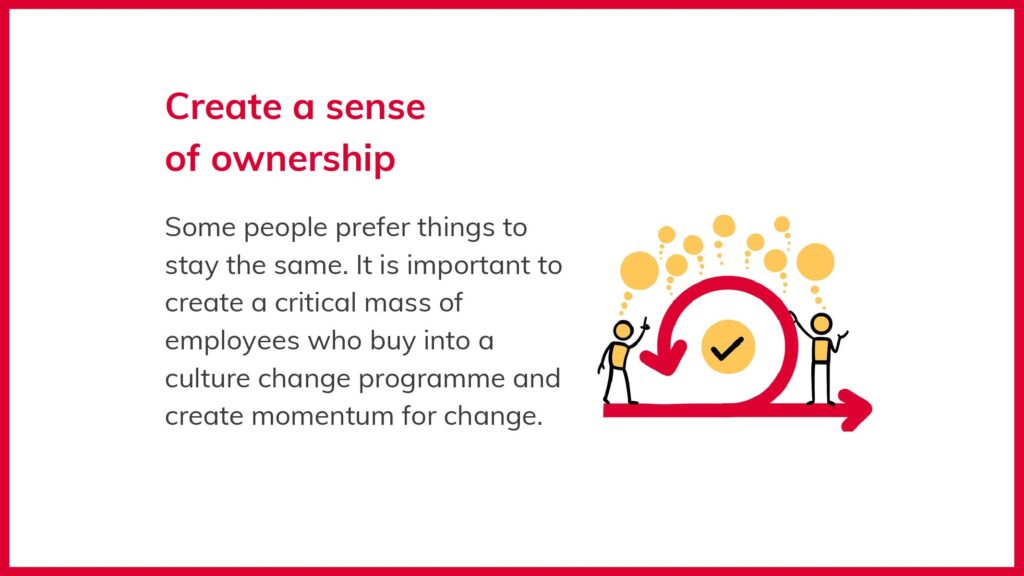
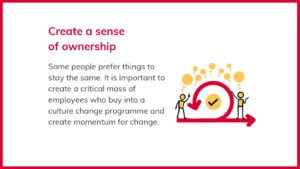
- Create a sense of ownership: Some people prefer things to stay the same. It is important to create a critical mass of employees who buy into a culture change programme and create momentum for change.
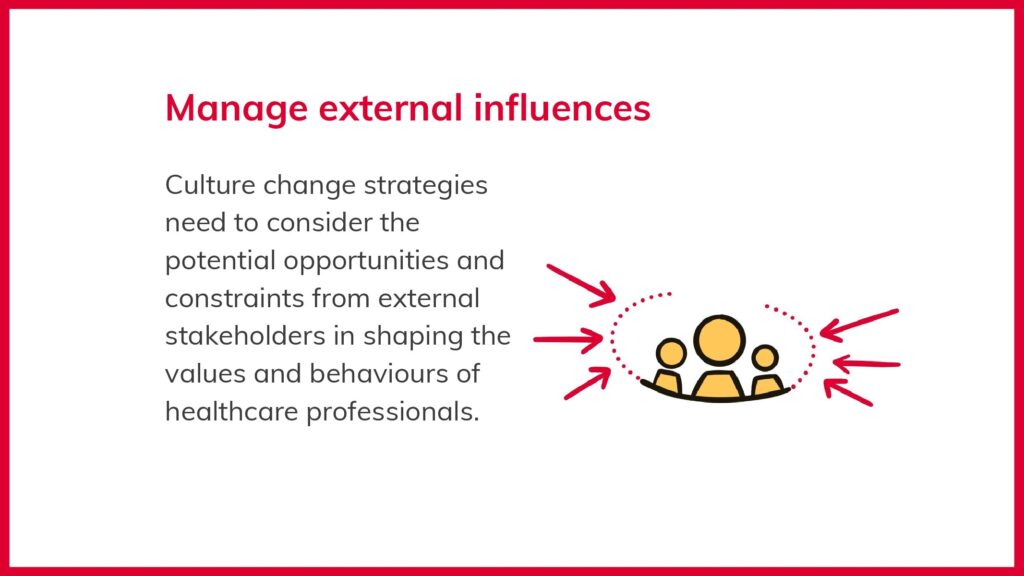
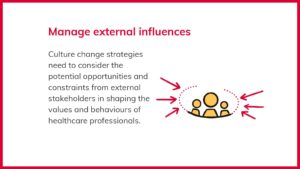
- Manage external influences: Culture change strategies need to consider the potential opportunities and constraints from external stakeholders in shaping the values and behaviours of healthcare professionals.
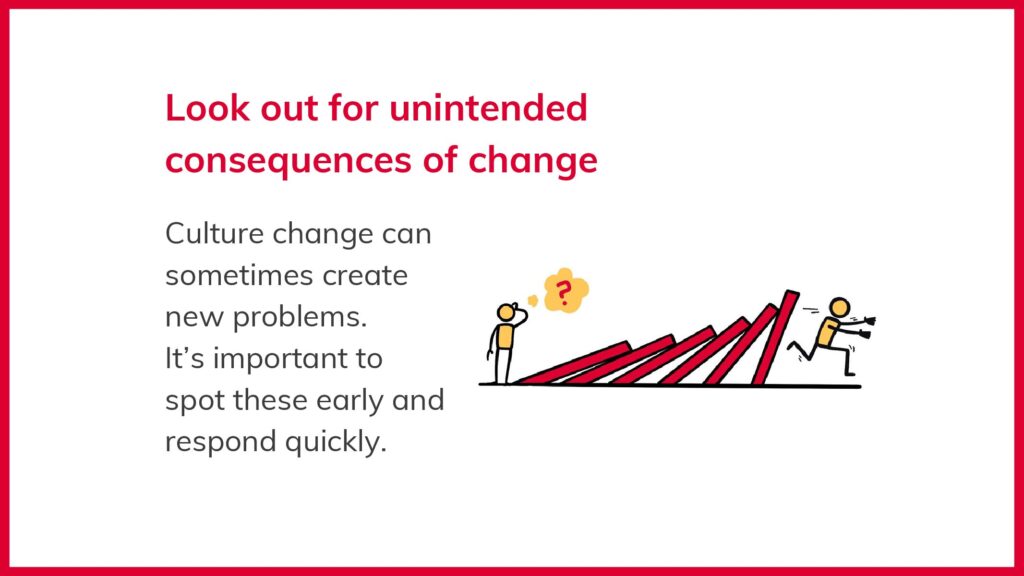
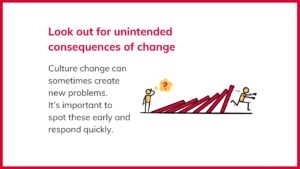
- Look out for unintended consequences of change: Culture change can sometimes create new problems. It’s important to spot these early and respond quickly.
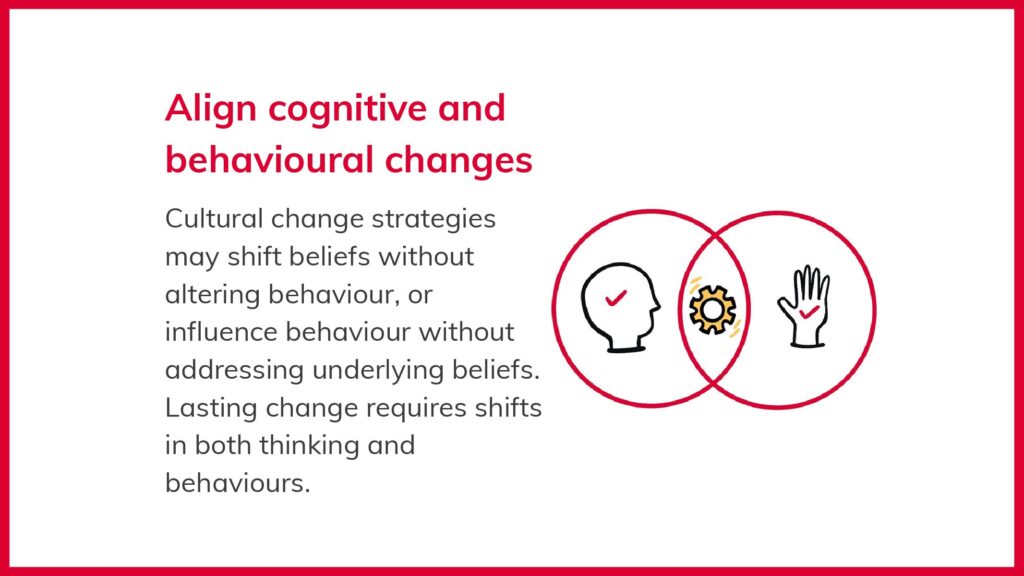
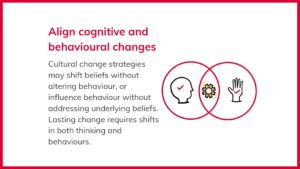
- Align cognitive and behavioural changes: Cultural change strategies may shift beliefs without altering behaviour, or influence behaviour without addressing underlying beliefs. Lasting change requires shifts in both thinking and behaviours.
Practical questions
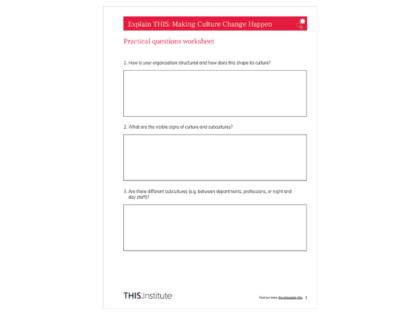
- How is your organisation structured and how does this shape its culture?
- What are the visible signs of culture and subcultures?
- Are there different subcultures (e.g. between departments, professions, or night and day staff)?
- How do these subcultures communicate and work together?
- Are there ways for staff to express their thoughts on culture and how it may be evolving?
- How do service users, families, and carers influence the culture of your organisation, and how could they be meaningfully involved in shaping or supporting culture change?
- What leadership styles are currently in place and how could leadership support a positive culture?
- What aspects of the current culture should be preserved, and what needs to change?
- What lessons can be learned from previous culture change efforts (both successful and unsuccessful)?
- Who needs to be involved in shaping and leading cultural change efforts?
- How can you ensure that culture change is co-created by staff at all levels, developing a sense of ownership?
- How might resistance to change be handled?
- How will changes be established in both thinking and behaviour?
- How will unintended consequences of change be identified and addressed?
- What training and support will people need to understand and adopt the new culture?
- How will you ensure that changes are sustained over time?
Further reading
THIS Institute | Russell Mannion
Making Culture Change Happen
https://doi.org/10.1017/9781009236935
Department of Health
Culture change in the NHS: Applying the lessons of the Francis Inquiries
https://assets.publishing.service.gov.uk/media/5a75b1fb40f0b67b3d5c87e7/culture-change-nhs.pdf
NHS Institute for Innovation and Improvement
Improvement Leaders’ Guide: Building and nurturing an improvement culture
https://www.england.nhs.uk/improvement-hub/wp-content/uploads/sites/44/2017/11/ILG-3.3-Building-and-Nurturing-an-Improvement-Culture.pdf
The King’s Fund
Improving NHS Culture
https://www.kingsfund.org.uk/insight-and-analysis/projects/improving-nhs-culture
NHS Resolution
Being fair 2 – improving organisational culture in the NHS
https://resolution.nhs.uk/2023/03/30/being-fair-2-improving-organisational-culture-in-the-nhs/
THIS Institute | Naomi J. Fulop and Angus I. G. Ramsay
Governance and Leadership
https://doi.org/10.1017/9781009309578
This resource was adapted from Making Culture Change Happen, by Russell Mannion, part of THIS Institute’s series ‘Elements of Improving Quality and Safety in Healthcare’.
Thank you to Ruben Gavriliuc, North London NHS Foundation Trust, and Emma Vittery, Royal College of Paediatrics and Child Health, for their insightful comments and recommendations.
Download the resources
Worksheet
You can download the practical questions as a printable worksheet, with space to note down your responses.
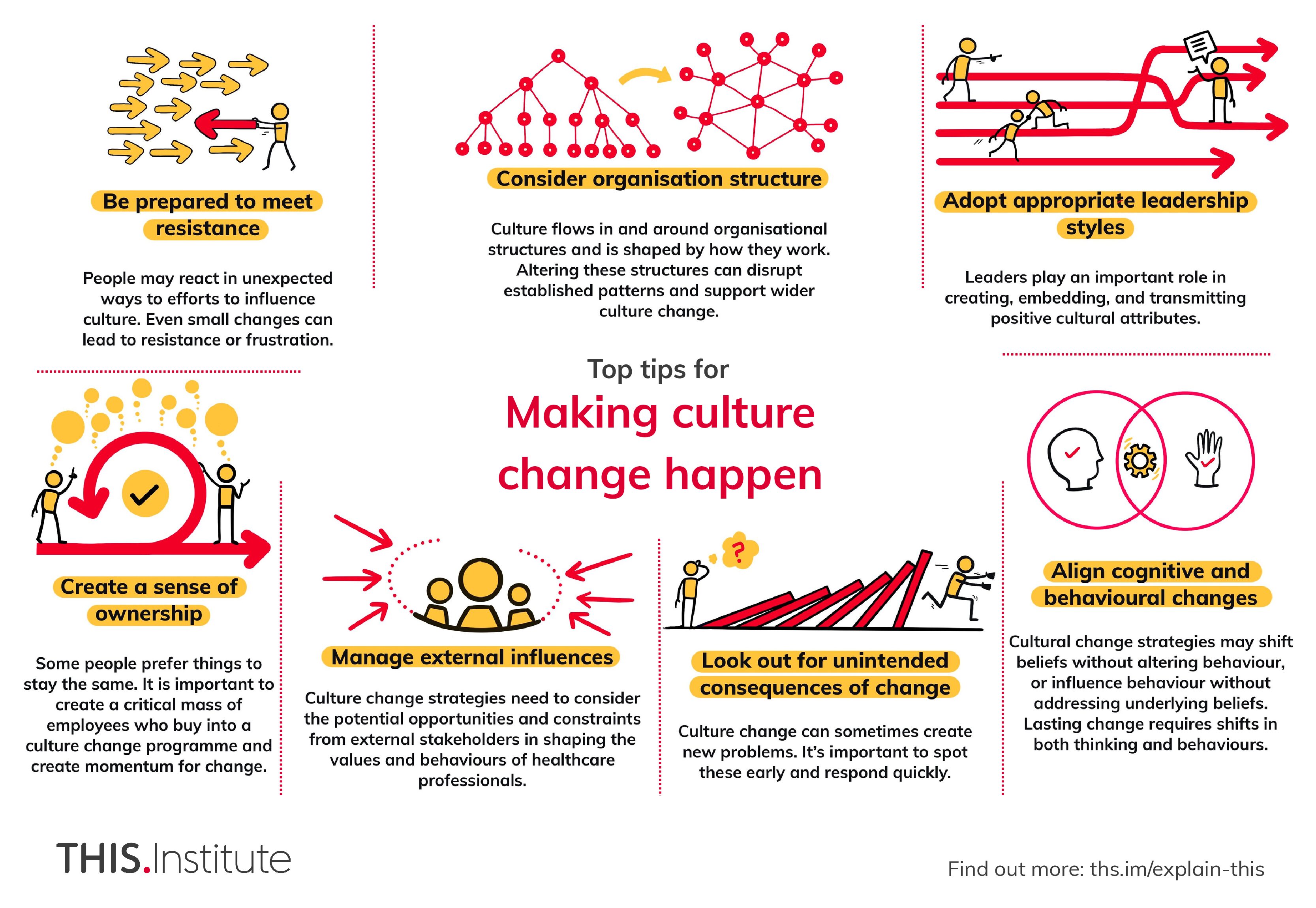
Sketchnote
Download the sketchnote, featuring seven top tips for making culture change happen.

Explore more microlearning resources
Explain THIS: Values and Ethics
Read more
Explain THIS: Measurement for Improvement
Read more
Explain THIS: Collaboration-Based Approaches
Read more
Explain THIS: Governance and Leadership
Read more
Explain THIS: Implementation Science
Read more
Explain THIS: Spread, Scale-Up, and Sustainability
Read more