



Martin GP, Akdur G, O’Hara J, Dixon-Woods M. Seven lessons for financial incentivisation schemes in healthcare: a qualitative study of NHS Resolution’s Maternity Incentive Scheme. Journal of the Royal Society of Medicine. 2026;0(0). doi:10.1177/01410768261476118
Seven lessons for financial incentivisation schemes in healthcare: a qualitative study of the Maternity Incentive Scheme
Published in:
Journal of the Royal Society of Medicine
Citation:

Contributors




Evaluating the Maternity Incentive Scheme (MIS) and incentives for improving healthcare
The government’s 10-Year Health Plan includes a renewed focus on financial incentives as a way of driving improvement across the NHS. This paper provides insight the strengths and limitations of financial incentives through an evaluation of the Maternity Incentive Scheme (MIS).
Launched in 2017, the MIS aims to improve maternity services by financially rewarding NHS trusts that declare compliance with 10 nationally defined safety actions. Trusts that meet all requirements receive a financial reimbursement.
What did we discover about the Maternity Incentive Scheme?
Our evaluation found that the MIS appeared successful in influencing organisational behaviour, particularly in getting attention from trust boards, where the financial implications of the scheme created strong incentives to engage. However, our findings also suggest that even an incentive scheme that appears to be functioning as intended can still result in less desirable outcomes.
Although the scheme tried to provide clarity on what was most important for the safety of mothers and babies, there remained many competing priorities for organisations, which meant that the ask of them was still complicated. This resulted in administrative burden for those responsible for responding to the MIS, and it could also give rise to some perverse incentives. For example trusts that felt they were unlikely to meet the requirements of the MIS could sometimes give up altogether, while trusts that were ‘nearly there’ could spend what some saw as disproportionate amounts of energy on small things that would make the difference between declaring compliance and falling short – instead of addressing other issues that might have a bigger impact on maternity quality and safety.
Although there was broad agreement that the MIS helped make maternity safety a higher priority and improved reported compliance, its impact on day-to-day practice within services was less obvious. As a result, there was uncertainty about whether the scheme led to overall improvements in safety.
The findings suggest that financial incentive schemes can be potentially effective but imperfect tools. The study offers valuable lessons for other similar initiatives, including those proposed in current NHS reform plans which call for a more consistent approach to using financial incentives to reward changes that deliver value and improve outcomes.
We identified seven lessons for those designing and implementing schemes of this kind, aimed at helping policymakers as they harness the power of incentivisation to drive healthcare improvement.
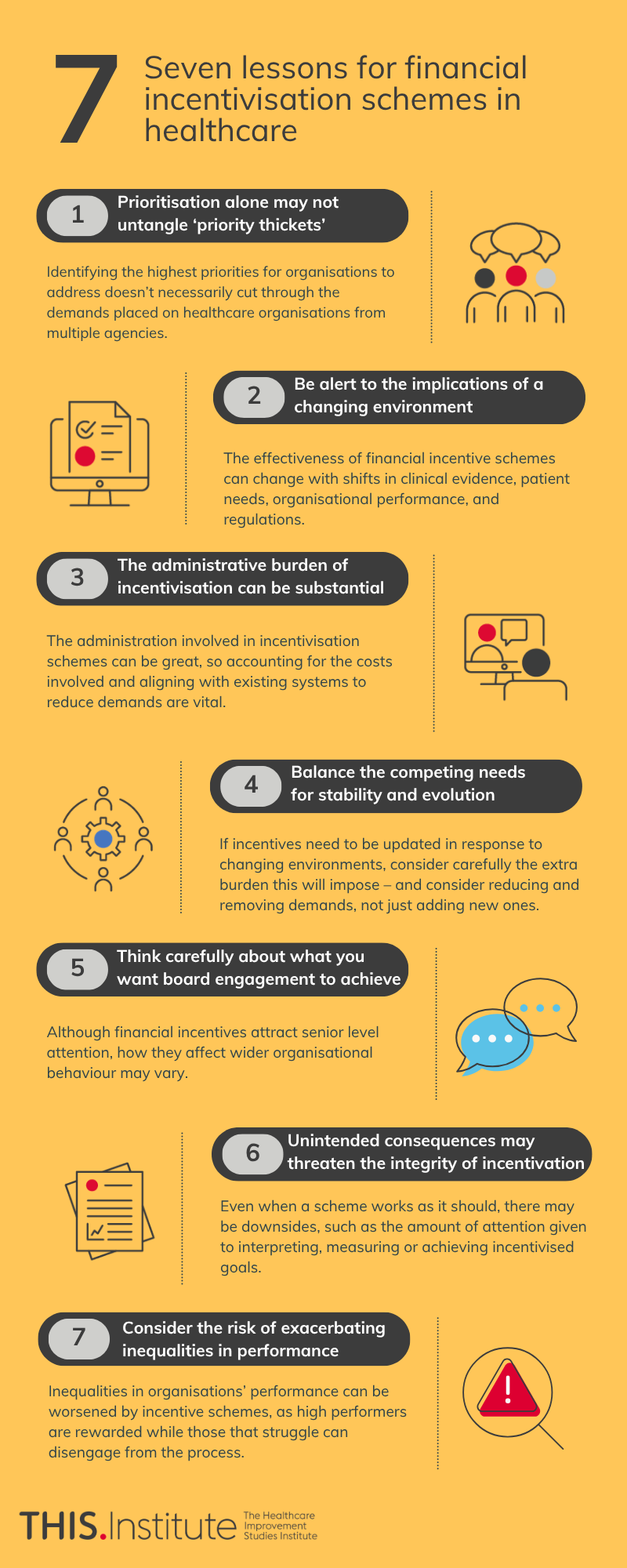
What are the seven lessons for financial incentivisation schemes in healthcare?
- Prioritisation alone may not untangle ‘priority thickets’
While it’s important to be clear about purpose and cut through the many different demands and expectations placed on healthcare organisations, it can be hard for any single agency to coordinate and simplify the ask, even when working with other influential bodies. - Be alert to the implications of a changing environment
Clinical developments, shifts in population need and changes in organisational performance may affect where incentives have the biggest impact. Changes in the regulatory environment may also affect the effectiveness of incentivisation. - The administrative burden of incentivisation can be substantial and the opportunity costs are real
There is a lot of work involved in interpreting requirements, setting up measurement systems, undertaking audits and improving quality, and this can impact on other important work. Requirements should be clearly laid out and aligned with existing reporting systems, and the costs of reporting need to be accounted for. - Balance the competing needs for stability and evolution
Keeping the purpose and objectives consistent and stable through time may ease the administrative burden of incentive schemes, but they also need to be able to respond to the changing environment. If new areas of activity need incentivising, consider whether existing incentives could be simplified or reduced. - Think carefully about what you want board engagement to achieve
Financial incentives appear to be effective in attracting organisational attention at senior levels, but how this translates into board behaviour may vary, as does the impact on behaviour at clinical services level. Theories of change for incentive systems should consider how they affect behaviour both within organisations and across the wider healthcare system. - Unintended consequences are not the only threat to integrity of incentivisation
While the potential unintended consequences of incentive schemes are well documented, even a scheme working as it is meant to may have downsides—for example, by distorting the level of attention given to interpreting, measuring or achieving incentivised goals. - Consider the risk of exacerbating inequalities in performance
Incentive schemes can risk increasing inequalities between high-performing and low-performing organisations, both directly, through resource allocation that rewards high-performers, and indirectly, if organisations that anticipate low likelihood of success become disengaged.